PSBayes
A per-seed Bayesian estimator of how much risk is still left in a fuzzing campaign. First-author paper, accepted at ICSE 2027.
- Role
- First of six authors. Implementation, experiments and writing.
- When
- Oct 2025 - Jun 2026
- Status
- Main research track, artifact public
- Context
- Accepted at ICSE 2027
- Stack
- Python
- LLVM
- libFuzzer
- Google FuzzBench
- Docker
- AWS EC2
The problem
Fuzzing can't prove there are no bugs left, so the real question is when to stop, and how much risk you still carry when you do. The standard estimators give each seed a single point estimate and don't say how much evidence sits behind it. A seed that has barely been fuzzed can then dominate the prediction.
PSBayes models each seed's success rate as its own Beta posterior. I came up with the per-seed model, built it, ran the experiments and wrote the paper as first of six authors. It was accepted at ICSE 2027, in the main research track.
How it works
- 1
Instrumented fuzzer
Patches to LLVM's libFuzzer so every run logs, per seed, how many attempts succeeded and how many failed.
- 2
Campaigns
Eight Google FuzzBench benchmarks on AWS, one container each, covering 18,861 discovery rounds.
- 3
Per-seed posterior
Each seed's mutation history is its own run of Bernoulli trials with a Beta posterior, so evidence builds up per seed and a barely-fuzzed seed can't dominate the estimate.
- 4
Two estimators
PSBayes99 uses a Bayes-factor threshold and is tuned for accuracy. PSBayesPM uses the posterior mean and is tuned for safety, so it almost never underestimates.
- 5
Shared ground truth
Every estimator, the baselines and ours, is scored against the same trials-to-discovery ground truth.
- 6
Artifact
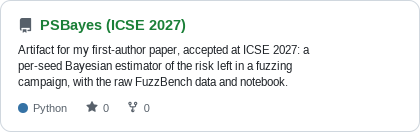
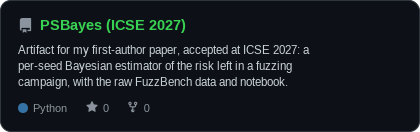
The raw campaign logs, the libFuzzer patch, the pinned FuzzBench fork and LLVM commit it ran on, and one notebook that runs every estimator and regenerates every table and figure in the paper.
Decisions and tradeoffs
- Per-seed instead of pooled statistics. Hard seeds keep their evidence even after they age out of the recent window.
- One shared ground truth for every estimator. Scoring the baselines on one ground truth and ours on another would compare apples to oranges.
- No oracle scaling factor. The estimator only uses what a fuzzer can see during a campaign, and that's the point of it.
- Two estimators for two costs. Some teams care about accuracy, others can't afford to stop early, so there's one of each.
What broke
- The scale mismatch. Single-thread predictions were being scored against a ten-fork maximum, which made every estimator look like it underestimated 68% of the time. On one benchmark the median ratio between the two was 76x. Switching everything to a single trials-to-discovery ground truth fixed it.
- A headline compared across two ground truths. A collaborator caught it, and we re-scored every estimator on the same ground truth with no new runs.
- A quantile bug. The model used the lower bound where it needed the upper one, and underestimation stayed inflated until it was fixed.
Results
| Result | What it measures | Source |
|---|---|---|
| ~24 points | Lower weighted accuracy error for PSBayes99 than prior residual-risk estimators | Accepted paper, across 8 FuzzBench benchmarks |
| 0.04% | How often PSBayesPM underestimated the remaining effort, for teams that can't afford to stop early | Accepted paper |
| 8 | Real-world FuzzBench benchmarks, from freetype2 and libxml to re2 and zlib | Artifact, data/raw |
| 18,861 | Discovery rounds across the campaigns | Paper evaluation |
~24 points
Lower weighted accuracy error for PSBayes99 than prior residual-risk estimators
Accepted paper, across 8 FuzzBench benchmarks
0.04%
How often PSBayesPM underestimated the remaining effort, for teams that can't afford to stop early
Accepted paper
8
Real-world FuzzBench benchmarks, from freetype2 and libxml to re2 and zlib
Artifact, data/raw
18,861
Discovery rounds across the campaigns
Paper evaluation
The artifact has the raw campaign logs and the notebook, so the paper's tables and figures can be rebuilt in 5 to 10 minutes on a laptop.
Limits
The evaluation covers one benchmark suite, eight FuzzBench programs, and the evaluated estimator assumes the fuzzer picks seeds uniformly.
Next project
rag-redteam
An open-source scanner that attacks your RAG pipeline for prompt injection and document leakage, and fails CI the moment it gets more exploitable.